
A recent social media post claimed that marriage was not instituted by God but invented by humans. The author argued that marriage existed long before the Book of Genesis was written, that many biblical figures had multiple wives, and that ancient civilizations treated marriage as a legal contract rather than a sacred institution. As a result, the post concluded that marriage is simply a human invention that has evolved over time.
At first glance, these arguments can seem convincing because they contain a number of historical facts. Ancient civilizations did have marriage laws before the Old Testament was written down. The patriarchs of Israel did practice polygamy. And marriage has taken many different forms throughout history and across cultures. However, do these facts really prove that God did not institute marriage?
Was Marriage Invented by Humans or Instituted by God?
The answer depends on asking the right question. The issue is not whether ancient societies practiced marriage before Genesis was written. Christians have never claimed that marriage began when Moses wrote the Book of Genesis. Rather, the question is whether Genesis records God’s original design for marriage at the beginning of human history, or whether marriage is nothing more than a social institution created by human societies for practical reasons.
To answer that question, we need to distinguish between history and theology, between describing what people did and prescribing what God intended. We also need to examine the claims carefully, instead of accepting conclusions simply because they sound persuasive.
In this article, we will consider both the historical evidence and the biblical evidence. We will examine ancient marriage practices, the marriages of the patriarchs, the teaching of Jesus, and the purpose of marriage in Scripture. By the end, we should be able to answer an important question: Was marriage invented by humans, or was it instituted by God?
Marriage Existed Before Genesis Was Written
One of the core claims made in the social media post is that humans were marrying thousands of years before the Book of Genesis was written. This statement is historically correct, but it does not prove the conclusion the author draws from it.
Most biblical scholars agree that Genesis was written down during the second millennium or first millennium BC, depending on their view of its authorship and composition. However, the events recorded in Genesis, including the creation of Adam and Eve, are presented as taking place long before the book itself was written. Christians have never believed that marriage began when Moses wrote the words of Genesis. They believe Genesis records what happened at the beginning of human history.
This is an important distinction. The date a historical account is written is not the same as the date of the events it describes. For example, a modern history book about Julius Caesar may be written more than two thousand years after his death, yet no one would argue that Julius Caesar only existed when the book was published. In the same way, the fact that Genesis was written after ancient civilizations already had marriage customs does not determine whether the events it records actually happened.
The social media post also points out that ancient civilizations such as Mesopotamia had marriage contracts long before Israel became a nation. This is also true. Archaeologists have discovered legal documents and law codes, including the Code of Hammurabi, that regulated marriage, inheritance, divorce, and property rights. These records show that marriage was an established social institution in the ancient Near East.
Was Marriage Invented by Humans?
However, these documents tell us how societies regulated marriage. They do not tell us where marriage originated. Governments regulate many aspects of life, but regulation does not necessarily mean they created the institution itself. Modern governments have laws governing adoption, inheritance, education, and contracts, yet no one concludes that governments invented families, learning, or promises.
The historical evidence therefore establishes that ancient societies recognized and regulated marriage. It does not answer the larger question of whether marriage was originally designed by God or developed entirely through human culture. To answer that question, we must turn to the biblical account itself.
Did God Institute Marriage?
The Bible’s teaching about marriage begins, not with Abraham, Moses, or the nation of Israel, but with creation itself. According to Genesis, marriage was not introduced as part of Israel’s law or culture. It was established before sin entered the world, before governments existed, and before any nation had been formed.
After creating Adam, God declared:
“It is not good that the man should be alone; I will make him a helper suitable for him.” (Genesis 2:18 – NASB)
This is the first time in the creation account that God says something is “not good.” Everything else in creation had been pronounced good, yet Adam’s aloneness was incomplete. God’s solution was not to create another man, a group of companions, or a social institution. He created one woman, Eve, as Adam’s corresponding partner.
Genesis then records the establishment of marriage:
“Therefore a man shall leave his father and his mother and hold fast to his wife, and they shall become one flesh.” (Genesis 2:24 – NASB)
This verse is significant for several reasons.
First, it speaks of a man and his wife. The language is singular, presenting one man and one woman becoming one flesh. The verse does not describe every form of marriage that would later exist in human history. Instead, it presents the relationship established at creation.
Second, marriage is described as a permanent union. The man leaves his parents, is joined to his wife, and together they become “one flesh.” This is far more than a legal contract. It describes a unique covenant relationship in which two individuals become united in a way that affects every area of life.
Third, this passage appears before the Fall. It is not part of the Law of Moses or the civil regulations given to Israel. It belongs to God’s created order. For this reason, Christians have traditionally understood Genesis 2:24 as revealing God’s original design for marriage rather than simply describing an ancient cultural practice.
This distinction is important. The Bible often records what people did without presenting it as God’s ideal. Genesis 2:24 is different. It is not describing a failure or compromise. It is describing God’s own work before sin distorted human relationships.
The question, then, is not whether later societies developed different forms of marriage. The question is whether God’s design at creation remains the standard against which all later definitions of marriage should be measured. As we shall see, Jesus answered that question directly.
If God Instituted Marriage, Why Did the Patriarchs Have Multiple Wives?
One of the strongest objections raised against the biblical view of marriage is that many of the Old Testament’s most well-known figures had multiple wives. Abraham had Sarah, Hagar, and later Keturah. Jacob married Leah and Rachel and also had children through Bilhah and Zilpah. David had several wives, and Solomon famously had hundreds of wives and concubines.
If God instituted marriage as one man and one woman, why did He allow these marriages to take place?
The answer begins with an important principle: the Bible often records what people did without approving of it.
This distinction between description and prescription is very important. A descriptive passage tells us what people did. A prescriptive passage tells us what God commands or intends. Confusing the two has led to many misunderstandings.
For example, the Bible records Noah’s drunkenness, Lot’s incest, David’s adultery, Peter’s denial of Christ, and Judas’s betrayal. No one argues that these actions are approved simply because they are recorded in Scripture. The Bible honestly records both faithfulness and failure.
The same principle applies to polygamy.
Polygamy means having more than one spouse. Polygyny refers to one man with multiple wives. Polyandry refers to one woman with multiple husbands.
Although the Old Testament records men having multiple wives, it also records the painful consequences that followed.
Abraham’s decision to have a child through Hagar brought conflict between Hagar and Sarah, division within the household, and lasting tension between their descendants (Genesis 16; 21).
Jacob’s marriages resulted in jealousy, rivalry, and constant competition between Leah and Rachel. Their relationship affected the entire family and contributed to bitterness among Jacob’s children (Genesis 29–30).
David’s family experienced repeated conflict, immorality, and violence. Although not every problem can be traced directly to polygamy, the fractured family relationships certainly did not reflect the peace God intended.
Solomon probably provides the clearest example. Scripture specifically states that his many wives turned his heart away from the Lord and led him into idolatry (1 Kings 11:1–8). Rather than presenting his marriages as a blessing, the Bible presents them as a major cause of his spiritual downfall.
It is also significant that nowhere does God command His people to take multiple wives. The Mosaic Law contains regulations concerning polygamous households, but these laws acknowledge that the practice existed. They do not establish it as God’s ideal. Just as the Law regulated divorce, slavery, and other realities within a fallen world, it also regulated situations that fell short of God’s original design.
The consistent pattern throughout Scripture is that departure from God’s design brings painful consequences. The patriarchs were men of faith, but they were also imperfect sinners. Their lives showed God’s grace despite human failure, not God’s approval of every decision they made.
This raises another important question.
If the examples of the patriarchs do not establish God’s ideal for marriage, where should we look?
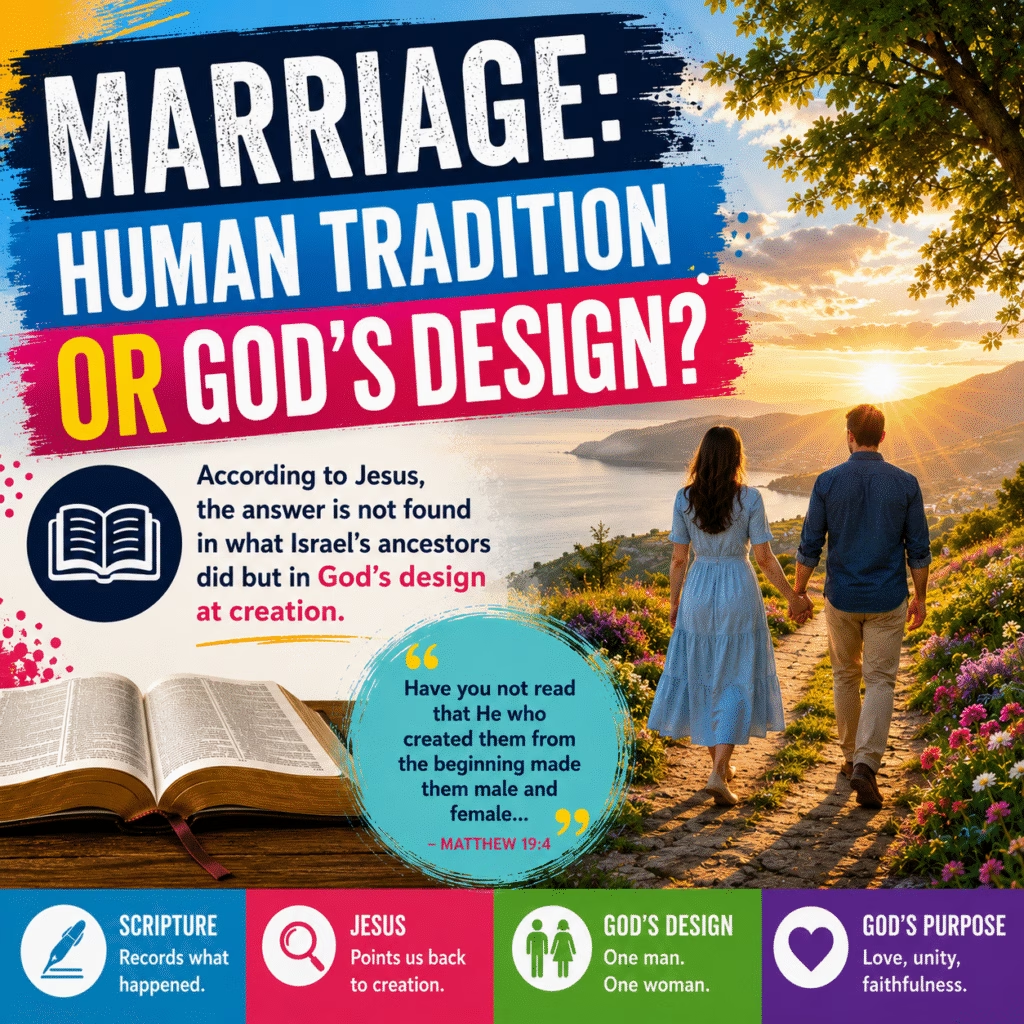
According to Jesus, the answer is not found in what Israel’s ancestors did but in God’s design at creation.
What Did Jesus Teach About Marriage?
The clearest answer to the question of God’s design for marriage comes from Jesus Himself. Interestingly, when He was asked about marriage and divorce, He did not appeal to the examples of Abraham, Jacob, David, or Solomon. Instead, He went back to the beginning.
The Pharisees asked Jesus whether it was lawful for a man to divorce his wife for any reason (Matthew 19:3). Rather than entering a debate about the different schools of Jewish interpretation, Jesus directed their attention to the creation account in Genesis.
He replied:
“Have you not read that He who created them from the beginning made them male and female, and said, ‘For this reason a man shall leave his father and his mother and be joined to his wife, and the two shall become one flesh’? So they are no longer two, but one flesh. Therefore what God has joined together, let no man separate.” (Matthew 19:4–6 – NASB)
Notice what Jesus does.
First, He combines Genesis 1:27 and Genesis 2:24. He begins with God creating humanity as male and female and then quotes the passage describing a man leaving his parents and being joined to his wife.
Second, Jesus attributes the institution of marriage to God. He concludes by saying, “What God has joined together.” Therefore, marriage is more than a human agreement or legal contract. It is a union that God Himself establishes.
Third, Jesus deliberately returns to creation rather than later Old Testament practices. He does not defend polygamy by pointing to the patriarchs, nor does He justify easy divorce because it was permitted under the Law of Moses. Instead, He treats Genesis as revealing God’s original intention.
The Pharisees immediately raised the obvious question:
They said to Him, “Why, then, did Moses command to give her a certificate of divorce and send her away?” (Matthew 19:7)
Jesus answered:
“ He *said to them, “Because of your hardness of heart Moses permitted you to divorce your wives; but from the beginning it has not been this way.” (Matthew 19:8)
This statement is very important.
Jesus distinguishes between what God originally intended and what Moses later permitted because of human sinfulness. The permission to divorce was not the original design. It was a concession made because people lived in a fallen world.
The same is true of other Old Testament practices. God gave laws about divorce, but that does not mean He wanted people to divorce.
The Mosaic Law also contains laws for situations in which a man had more than one wife. For example, Exodus 21:10 required a husband who took another wife to continue providing food, clothing, and marital rights for his first wife. Deuteronomy 21:15–17 protected the inheritance rights of the firstborn son in a polygamous household. These laws did not command or encourage polygamy. They recognized that the practice existed and protected women and children from being treated unfairly. T
The fact that polygamy existed among God’s people did not make it God’s ideal or mean that He approved of it.
In fact, Israel’s kings were specifically warned not to multiply wives for themselves because doing so would turn their hearts away from the Lord (Deuteronomy 17:17).
For Jesus, the standard was never the customs of ancient Israel or the practices of its patriarchs. The standard was the beginning.
This is why Christians believe God’s design for marriage is found in Genesis rather than in the later examples of Abraham, Jacob, David, or Solomon. Jesus Himself pointed beyond Israel’s history to creation, affirming that God’s intention from the beginning was the union of one man and one woman becoming one flesh.
Does Cultural Diversity Prove Marriage was invented by Humans?
The social media post also argues that because marriage has taken many different forms throughout history, it must be a human invention rather than something instituted by God.
It is certainly true that cultures have practiced marriage in different ways. Throughout history there have been societies that accepted polygyny (one man with multiple wives), others that practiced polyandry (one woman with multiple husbands), and still others that developed customs such as arranged marriages, ghost marriages, or families in which the husband moved into the wife’s household. Anthropologists have documented a remarkable variety of marriage traditions around the world.
However, this diversity does not answer the question of where marriage originated.
Different cultures have also held very different views on slavery, justice, inheritance, child sacrifice, and the value of human life. Some practices have been accepted in one society and condemned in another. The existence of different customs does not prove that there is no objective moral standard. It simply shows that people and societies do not always live according to the same standard.
The Bible repeatedly shows that humanity has departed from God’s design in many areas of life because of sin. The existence of practices that differ from God’s will should not surprise us. In fact, Scripture expects it.
This is why Christians do not determine what is right simply by looking at what most cultures have done or believed. If the majority determined what was true, then slavery, idolatry, and child sacrifice would all have been considered morally acceptable at various points in history.
Instead, Christians begin with God’s revelation.
The question is not, “What have people believed or done?”
The question is “What has God revealed?”
According to Jesus, the answer is found in the creation account, where God established marriage as the lifelong union of one man and one woman.
The variety of marriage customs throughout history tells us a great deal about human cultures. It does not tell us whether those customs reflect God’s original design. That question can only be answered by examining what God has revealed in Scripture.
Is Marriage Only a Human Contract?
Another claim often made is that marriage began as nothing more than a business arrangement. Ancient marriage contracts certainly focused on practical matters such as dowries, inheritance, property, and the legitimacy of children. The Code of Hammurabi and other ancient law codes show that these issues were important in the ancient world.
No Christian should deny these historical facts. Marriage has always had legal and economic implications. Throughout history, it has affected inheritance, family alliances, financial responsibilities, and the care of children. Civil governments have therefore recognized and regulated marriage for thousands of years.
However, the fact that marriage has legal aspects does not mean it is only a legal institution.
Here is an example:
When two people purchase a house, they sign legal documents that establish ownership and protect their rights. Those documents are real and important, but they do not create love, friendship, or commitment. They simply recognize and protect an existing relationship or agreement.
The same is true of marriage. A marriage certificate records that a marriage exists, but it does not create the one-flesh relationship described in Genesis. The legal contract recognizes the marriage. It is not the source of the marriage.
The Bible presents marriage as far more than a civil agreement. Before there were governments, courts, or written contracts, God declared:
“It is not good that the man should be alone.” (Genesis 2:18)
He then created Eve and joined her to Adam. Genesis describes marriage as a relationship of companionship, covenant, and unity in which a man and a woman become “one flesh.” These truths existed before any human government established laws concerning marriage.
This does not mean civil marriage is unimportant. Governments have a legitimate role in recognizing marriages, protecting spouses and children, and establishing legal responsibilities. Christians should respect these laws where they do not conflict with God’s commands. But recognizing a marriage is different from creating marriage.
Throughout history, societies have defined marriage in different ways and attached different legal rights to it. Those definitions may change from one culture to another. According to Scripture, however, God’s design for marriage does not change. It was established by the Creator before any human government existed.
Therefore, the historical evidence and the biblical evidence point to different conclusions. History shows that human societies have regulated marriage in many different ways. Scripture teaches that the institution itself began with God at creation.
Conclusion
The claim that marriage is a human invention often sounds persuasive because it is built on genuine historical facts. Ancient civilizations had marriage contracts before the Book of Genesis was written. Marriage took different forms in many cultures. Several of the Old Testament patriarchs had multiple wives. None of these facts should be ignored or denied.
However, historical facts do not always support the conclusions people draw from them.
The existence of marriage contracts shows that ancient societies regulated marriage. It does not show that they invented it. The examples of polygamy in the Old Testament show what some people did. They do not establish God’s ideal for marriage. The variety of marriage customs throughout history demonstrates that human cultures have differed widely. It does not answer the question of what God intended from the beginning.
For Christians, the ultimate authority is not ancient culture, it is God’s revelation. This is why Jesus did not point His listeners to Abraham, Jacob, David, or Solomon when asked about marriage. He pointed them back to creation.
When Jesus returned to Genesis, He affirmed that marriage was established by God as the lifelong union of one man and one woman becoming one flesh. Human societies have often departed from that design, but the original pattern has not changed.
Ultimately, the question is the same one Jesus answered. Should we look to the changing customs of human societies, or should we return to God’s design from the beginning?
As Christians, our answer must be the same as Jesus’ answer: “From the beginning.”
This article answers:
- Did God Really Institute Marriage?
- Was Marriage Invented by Humans or Instituted by God?
- Does the Bible Teach That Marriage Is Between One Man and One Woman?
- If God Created Marriage, Why Did Bible Characters Have Multiple Wives?
- Was Marriage Invented by Humans or Instituted by God?
- Did Marriage Exist Before the Bible?
- Does the Bible Approve of Polygamy?
- What Is God’s Original Design for Marriage?
- Did Christianity Invent Marriage?

Written by Francois Meyer (PhD, DDiv, DTh)
Visit the online store for courses and books