Does trusting God mean doing nothing? What does “Wait on the Lord” actually mean? Why do many Christians feel abandoned after “Trusting God”?
When “Just Trust God” Becomes Passivity
Modern Christianity is filled with comforting phrases:
- “Let go and let God.”
- “God will handle it.”
- “Just have faith.”
- “Stop trying so hard.”
- “God is in control.”
- “Rest in Him.”
- “Wait on the Lord.”
Most people who say these things genuinely mean well.
But when these phrases are repeated without wisdom, discernment, responsibility, accountability, or biblical context, they can slowly create something spiritually and psychologically dangerous:
Passivity disguised as faith.
And sadly, many people only realize the damage after life begins falling apart.
Some become emotionally dependent.
Some stop taking responsibility.
Some avoid reality.
Some become trapped in cycles of helplessness.
And others eventually become angry at God Himself because the emotional promises they were given did not match reality.
Trusting God Is Not the Problem
Scripture repeatedly calls believers to trust God during hardship, suffering, uncertainty, fear, weakness, and difficult seasons.
Proverbs 3:5–6, Psalm 37:3–7, Isaiah 40:31, and Philippians 4:6–7 are only a few examples where believers are called to trust God while continuing faithfully before Him.
But biblical trust was never presented as emotional passivity, denial of reality, abandoning responsibility, refusing wisdom, avoiding difficult decisions, or expecting life to magically fix itself.
The problem is not faith.
The problem is how modern inspirational Christianity sometimes redefines faith into emotional surrender without responsibility.
Does Trusting God Mean Doing Nothing?
Rest in God Does Not Mean Doing Nothing
One of the greatest misunderstandings in modern Christianity is the idea of “rest.”
Many people hear:
“Rest in God”
and interpret it as stop trying, stop thinking, stop acting, stop planning, stop confronting reality, and simply wait for God to fix everything.

That is not what biblical rest means.
What does resting in the Lord mean?
Biblical rest primarily refers to finding inner peace, stability, trust, and groundedness in God even while facing difficult circumstances.
Philippians 4:6–7 describes the peace of God guarding the heart and mind, not the removal of every difficult circumstance.
That peace matters because fear, panic, anxiety, emotional overload, and desperation often lead people into poor decisions.
A person who becomes internally calmer in God often thinks more clearly, responds less impulsively, makes wiser decisions, discerns situations more accurately, and handles hardship more steadily.
Biblical peace is not always the removal of problems around a person.
Very often, it is stability within the person while facing problems.
God’s peace does not always instantly remove the storm.
But it can steady the person within the storm.
What Does Waiting On The Lord Mean?
Another phrase that is often misunderstood is:
“Wait on the Lord.”
“Wait on the Lord” does not mean passive inactivity.
Many people interpret this as:
- doing nothing,
- emotional paralysis,
- passively waiting,
- or expecting God to suddenly solve every problem while requiring no wisdom, effort, growth, or perseverance from their side.
But throughout Scripture, waiting on the Lord was never passive helplessness.
It referred to:
- remaining faithful,
- continuing in obedience,
- trusting God’s timing,
- enduring hardship,
- remaining spiritually grounded,
- seeking wisdom,
- persevering through uncertainty,
- and refusing to abandon truth while waiting for direction or breakthrough.
God Is Not a Magical Crisis Removal System
One of the most damaging distortions in parts of modern Christianity is the idea that faith means problems can simply be “commanded away.”
This often sounds like:
“I command your depression to leave!”
“I declare financial breakthrough!”
“I command your anxiety to go!”
“Receive your miracle!”
“Your suffering ends today!”
“God is removing every obstacle right now!”
And people are sometimes led to believe that if they “receive it by faith,” then all fear will instantly disappear, trauma will vanish immediately, finances will suddenly fix themselves, consequences will evaporate, and life will improve without wisdom, accountability, growth, discipline, or action.
That is not how God normally works in Scripture.
And frankly, when someone begins shouting at your problems as if Christianity is a magical spell system, alarm bells should begin ringing.
At some point, the sheer number of red flags stops looking like church revival and starts looking like a carnival. Carnivals are usually full of noise, spectacle, emotional hype, and people pretending to have magical solutions.
Theatrics should not be mistaken for spirituality, and emotional intensity is not automatically a move of God.
When everything starts sounding more theatrical than truthful, discernment matters.
Or to say it a little more bluntly:
When a preacher starts dramatically commanding every problem in your life to disappear instantly in the Name of Jesus, … RUN!
Because Christianity is not magic.
And God is not manipulated through emotional intensity, repeated declarations, or theatrical performances.
Biblical faith does not bypass reality.
It remains faithful within reality.
Very often, God works through:
- wisdom,
- endurance,
- perseverance,
- discipline,
- renewed thinking,
- gradual growth,
- faithful action,
- correction,
- maturity,
- and long-term transformation.
Sometimes God changes circumstances quickly.
Sometimes He strengthens the person within the circumstances.
And often both happen progressively over time.
Trauma Makes Simplistic Faith Messages More Dangerous
This becomes especially serious when dealing with trauma, depression, anxiety, grief, abuse, emotional exhaustion, chronic stress, or long-term psychological struggles.
People experiencing trauma often already struggle with helplessness, passivity, confusion, fear, shame, avoidance, emotional overwhelm, and difficulty making decisions.
When hurting people are repeatedly told:
“Just trust God,”
“Just pray more,”
“Just let go,”
or:
“You need more faith,”
without also addressing accountability, wisdom, emotional conditioning, practical action, support, healing processes, renewed thinking, healthy boundaries, and personal responsibility, the result can unintentionally deepen hopelessness.
The Mind Does Not Instantly Change
Fear, anxiety, destructive thinking patterns, emotional conditioning, and trauma responses often become deeply ingrained over time.
Scripture repeatedly speaks about renewing the mind, wisdom, discernment, discipline, endurance, perseverance, correction, self-control, and spiritual growth.
Romans 12:2 speaks directly about the renewing of the mind, while Proverbs repeatedly connects wisdom, discipline, correction, and discernment to spiritual growth.
These are processes.
Strongholds are often deeply rooted patterns of thinking, fear, beliefs, emotional conditioning, and reactions that oppose truth and reinforce destructive ways of living.
And strongholds are not usually removed through a brief emotional moment, emotional church intervention, or motivational slogan.
Real healing often involves truth, time, wisdom, responsibility, discernment, support, accountability, renewed thinking, perseverance, and gradual transformation.
Emotional Comfort Is Not Always Healing
Many modern faith messages prioritize emotional comfort above truth.
But emotional relief is not always genuine healing.
Sometimes healing involves confronting reality honestly, facing painful truth, taking responsibility, breaking destructive habits, rebuilding slowly, making difficult changes, learning discernment, and growing through hardship.
That process is often uncomfortable.
But discomfort is not abandonment by God.
Biblical Faith Was Never Passive
Throughout Scripture, people trusted God while still acting faithfully, wisely, courageously, and responsibly.
Noah trusted God.
But Noah still built the ark.
Joseph trusted God.
But Joseph still planned during famine.
Nehemiah trusted God.
But Nehemiah still rebuilt the wall while armed and alert.
David trusted God.
But David still fought battles and sought wisdom.
Paul trusted God.
But Paul still endured hardship, corrected error, reasoned carefully, persevered, worked, and continued faithfully.
Biblical faith was never passive inactivity.
Faith and responsibility were never enemies.
Why Some Christians Eventually Feel Abandoned
Many people are not rejecting God Himself.
Often, they are reacting to oversimplified versions of Christianity that promised emotional relief without preparing them for responsibility, suffering, endurance, discernment, growth, wisdom, perseverance, consequences, or reality itself.
When emotional slogans fail to fix real life, people can begin feeling abandoned, ashamed, spiritually confused, emotionally betrayed, or blamed for “not having enough faith.”
Some eventually swing to the opposite extreme and conclude:
“I had to save myself because God did nothing.”
But biblical faith was never passive waiting for life to magically improve.
Compassion and Accountability Must Both Exist
People who are suffering need compassion.
But they also need truth.
Real healing often requires compassion without condemnation and accountability without cruelty.
Not performance pressure.
But also not the removal of responsibility, discernment, wisdom, perseverance, growth, and faithful action from the conversation.
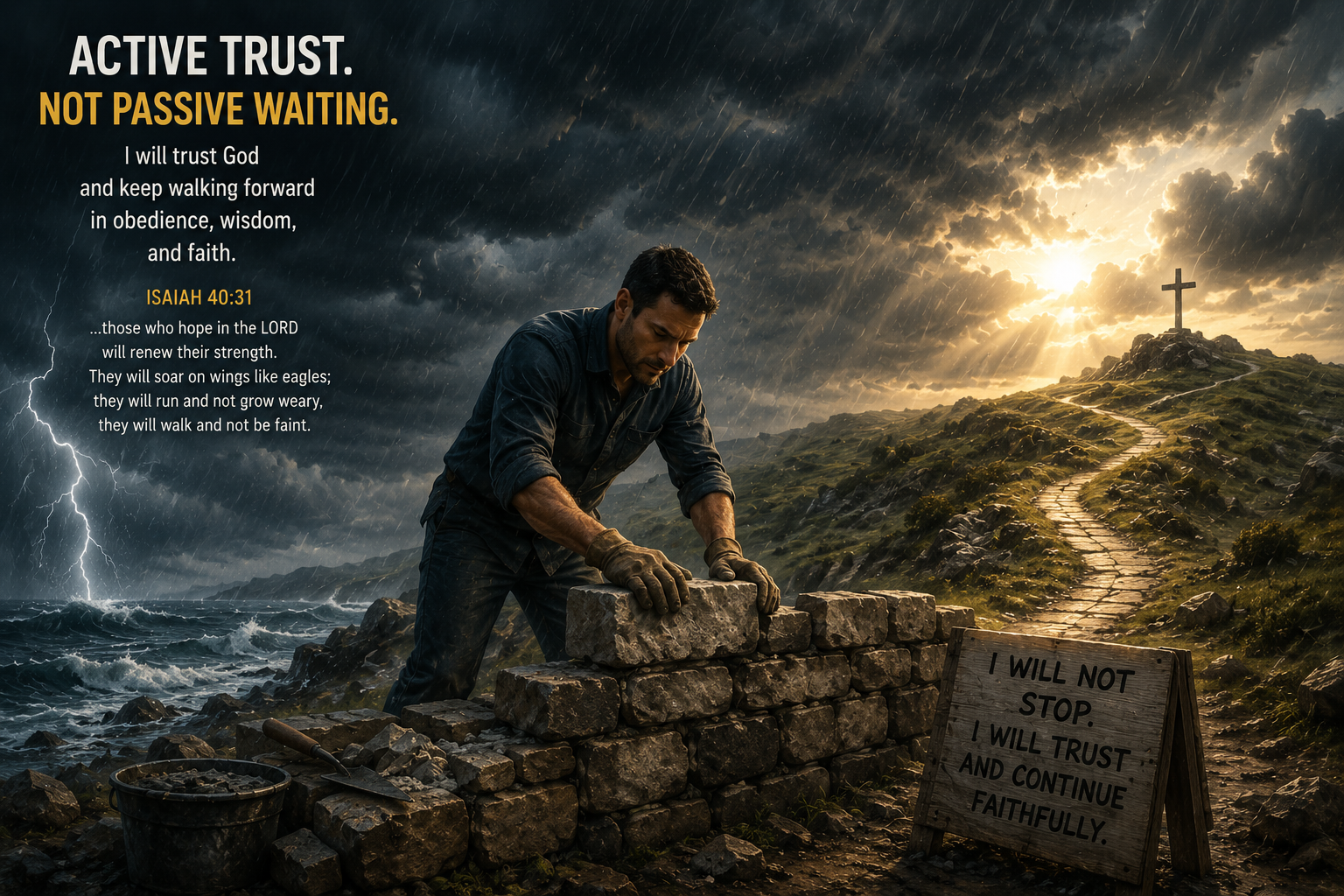
And part of trusting God and waiting on the Lord is learning to find peace in Him, because a calmer mind often sees situations more clearly and makes wiser decisions.
True wisdom comes from God. Scripture clearly teaches that God gives wisdom to those who ask. But the conditions surrounding wisdom are important and are often ignored in modern Christianity.
You cannot live in continual distrust, reject accountability, abandon personal responsibility, refuse correction, ignore wisdom, neglect obedience to God’s Word, avoid regular repentance, and then expect God to suddenly provide miraculous solutions to every self-destructive situation. James 1 also connects wisdom to faith, humility, endurance, and obedience rather than double-minded living.
Even King Solomon, despite being granted extraordinary wisdom by God, often had more questions than answers.
Yes, his wisdom caused him to ask profound questions. But they were questions flowing from wisdom, discernment, observation, and deep reflection.
And in Ecclesiastes, we see something important:
many of Solomon’s questions were not answered immediately.
Some answers only became clearer over time.
Although much of Ecclesiastes is philosophical in nature and may not directly apply to every life situation, an important principle still emerges:
Wisdom from God does not always mean instant answers, instant knowledge, or instant solutions.
Sometimes wisdom means:
- asking better questions,
- seeing situations from a clearer perspective,
- recognizing patterns more accurately,
- researching more carefully,
- thinking more critically,
- and making better informed choices.
And better choices often lead to better outcomes over time.
So sometimes, when you feel abandoned by God because you had to struggle, endure, think, rebuild, persevere, and slowly climb out of despair yourself, you may fail to realize something important:
Perhaps God was not absent at all.
Perhaps He was guiding you through wisdom, discernment, endurance, growth, wiser thinking, and the gradual process of learning to think and live more in line with the wise guidance He provides throughout Scripture.
And that brings us back to the original reason this discussion matters in the first place.
Because many people are incorrectly taught that their struggles are mainly caused by outside spiritual forces that can simply be removed through the dramatic and theatrical spiritual intervention by another person, instead of learning spiritual maturity, wisdom, accountability, discernment, and faithful endurance.
Final Thoughts
Biblical trust in God is never passive surrender to helplessness.
It is active trust.
A trust that walks forward in obedience, responsibility, accountability, and faith.
A trust that endures.
A trust that obeys.
A trust that learns.
A trust that grows.
A trust that perseveres.
A trust that continues faithfully even during hardship.
Resting in God does not mean abandoning wisdom, effort, responsibility, or discernment.
It means finding peace in Him so that fear, panic, hopelessness, and emotional chaos do not control your thinking, choices, and actions.
And waiting on the Lord does not mean doing nothing.
It means remaining faithful and continuing to walk forward wisely, patiently, responsibly, truthfully, and obediently before God, especially during hardship.
Throughout Scripture, faithful endurance is repeatedly connected to spiritual maturity, perseverance, wisdom, and growth rather than passive escape from hardship. – James 1:2–4, Romans 5:3–5
“58 Therefore, my beloved brothers and sisters, be firm, immovable, always excelling in the work of the Lord, knowing that your labor is not in vain in the Lord.” – 1 Corinthians 15:58 New American Standard Bible
In This Article, We Addressed Questions Such As:
- Does trusting God mean doing nothing?
- What does “wait on the Lord” actually mean?
- Does “rest in God” mean stop trying?
- Why can “let go and let God” become dangerous?
- What does biblical trust in God really mean?
- Is “just have faith” hurting some Christians?
- Does God expect you to simply wait for miracles?
- What does “rest in God” really mean in the Bible?
- Why do some Christians feel abandoned after “trusting God”?
- What is the difference between biblical trust and passive Christianity?
- Why is “God will fix everything” not the full Gospel?
- Can faith become passive and unhealthy?
- What happens when Christians mistake passivity for faith?

Written by Francois Meyer (DTh, DDiv, PhD)
Join the live Sunday sermons on YouTube for Scripture-focused teaching in a quiet, pressure-free environment.
You can view the Live Bible Teaching on Sundays
Join us every Sunday for in-depth Bible teaching.
🔔 Subscribe and turn on notifications.
🕘 Live at 09:30 (South Africa time)
🌍 Check your local time here
Spend some time on the website for more topics, studies, and blogs.
You will find answers to many questions in the blogs.
Visit the online store to enroll in a deep study of the Bible.