
When Authority Becomes Coercion: A Necessary but Uncomfortable Conversation
There are topics that divide opinions, and then there are topics that expose realities people would rather not confront. Spiritual bullying in the church belongs firmly in the second category. It is uncomfortable not because it is rare, but because it is common. It is offensive not because it is untrue, but because it reveals patterns many have participated in, defended, or quietly tolerated.
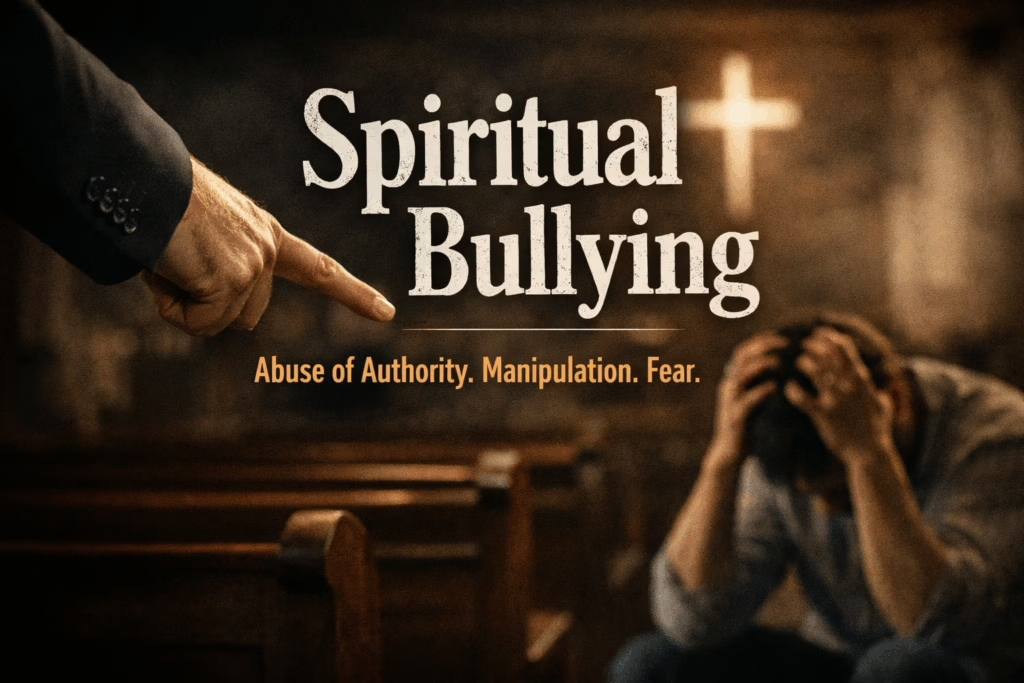
Spiritual bullying is not limited to fringe movements or obviously abusive leaders. It exists in mainstream churches, small fellowships, charismatic circles, and even highly structured, doctrinally conservative communities. It does not always shout. It often whispers. It does not always threaten. It often persuades, pressures, and spiritually reframes resistance until the individuals doubts their own conscience.
Even more troubling is this: churches that pride themselves on being “grace-based” and anti-legalistic are often more susceptible to spiritual bullying than those with clearly defined moral frameworks. When objective truth is replaced with emotional authority, control does not disappear, it simply changes shape.
What Spiritual Bullying Is (And What It Is Not)
Spiritual bullying occurs when spiritual language, authority, or social pressure is used to coerce behavior, suppress conscience, or silence disagreement under the guise of faithfulness, unity, or submission to God.
It commonly includes:
- Pressuring individuals to comply “for the sake of unity”
- Framing disagreement as rebellion, pride, or lack of faith
- Using “God told me” claims to override discernment
- Demanding access to personal thoughts, struggles, or confessions
- Imposing social, spiritual, or emotional consequences for noncompliance
Spiritual bullying does not require shouting, public humiliation, or overt threats. In fact, it is most effective when it appears calm, caring, and spiritually mature.
What spiritual bullying is not:
- Biblical correction rooted in Scripture and offered humbly
- Pastoral guidance given with consent
- Church discipline applied with due process and accountability
- Loving confrontation aimed at repentance, not control
The defining difference is simple:
Correction appeals to conscience. Bullying overrides it.
The Antinomian Illusion: Why “Grace-Only” Cultures Can Be Worse
Antinomianism is the belief that God’s moral law is no longer spiritually relevant for believers, dismissing obedience as unnecessary under the banner of grace, freedom, and love. Yet, in practice, it often replaces moral clarity with subtle control rather than true freedom.
When obedience, doctrine, and moral clarity are dismissed as “legalism,” something else fills the vacuum: personality-based authority.
In such environments:
- Leaders become the interpretive lens for truth
- Emotional agreement replaces doctrinal agreement
- Loyalty becomes the highest virtue
- Dissent is framed as unloving or divisive
- Boundaries are labeled as judgment
Without objective standards, authority becomes subjective. The phrase “we are led by the Spirit” can quickly become “we are led by whoever speaks most confidently in spiritual language.”
Ironically, antinomian systems often exert greater pressure than legalistic ones, because there is no clear rulebook to appeal to. Everything becomes relational, emotional, and unspoken, making resistance feel like betrayal rather than disagreement.
From the Pulpit to the Door: How Widespread It Is
Spiritual bullying is not confined to senior leadership. It operates at every level of church culture.
It can come from:
- A pastor who implies spiritual danger if members leave
- A prophet who demands obedience “to the word of the Lord”
- A small group leader who polices beliefs or emotions
- A prayer partner who insists on confessions
- A greeter at the door who subtly communicates who “belongs” and who does not
The authority may be formal or informal, but the mechanism is the same: spiritual pressure backed by fear of exclusion.
Many victims struggle to explain what happened because there is often no single dramatic event; instead, there is a gradual erosion of confidence, discernment, and the personal ability and freedom to think, decide, and act responsibly before God, without being controlled, coerced, or overridden by others.
Common Tactics of Spiritual Bullying
Spiritual bullying follows recognizable patterns. Once seen, they are difficult to unsee.
1. Spiritualized Gaslighting
Spiritualized gaslighting often sounds gentle, wise, and well-intentioned, yet its effect is deeply corrosive. Instead of addressing concerns honestly, it reframes them as spiritual defects, gradually training individuals to doubt their own discernment and suppress legitimate questions in order to appear faithful.
Here are three examples:
a. “You are feeling unsettled because your heart is not right with God.”
This reframes legitimate concerns as spiritual failure, discouraging self-trust.
b. “If you were spiritually mature, you would not be questioning this.”
This reframes discernment as immaturity, conditioning the individual to suppress questions and distrust their own judgment in order to appear faithful.
c. “Pray about it more, and you will eventually see why this is right.”
This implies that continued concern is evidence of spiritual deficiency rather than a valid warning signal.
All three examples above reinforce the same mechanism: concern is treated as sin, and silence as maturity.
2. False Unity Language
False unity language presents itself as humility and harmony, but in reality it shuts down discernment by equating questioning with disloyalty and silence with faithfulness.
“We do not question leadership here.”
Unity becomes uniformity, and peace becomes silence.
3. Selective Scripture Use
Selective Scripture use elevates certain passages to protect authority while quietly excluding others that demand accountability, distorting the balance of God’s Word to serve control rather than truth.
Submission verses are emphasized. Accountability verses are ignored.
Scripture becomes a tool, not a standard.
4. Fear of Exclusion
Fear of exclusion is used to enforce compliance by making belonging conditional, turning community, relationships, and even spiritual security into tools of pressure rather than expressions of grace.
Loss of community, friendships, ministry roles, or perceived salvation becomes leverage.
5. Moral Inconsistency
Moral inconsistency undermines trust by applying grace unevenly, shielding those in authority while scrutinizing or disciplining those who raise concerns.
Grace is preached broadly, but selectively applied. Leaders receive grace. Questioners receive correction.
6. Public Virtue, Private Control
Public messaging emphasizes love and freedom, while private conversations enforce conformity.
This tactic creates a sharp contrast between outward appearance and inner reality, projecting an image of love and freedom publicly while exerting quiet pressure and control behind closed doors.
None of these require malicious intent. Many spiritual bullies genuinely believe they are protecting the church or defending truth. Sincerity, however, does not neutralize harm.
Why People Stay Silent
Those subjected to spiritual bullying rarely leave immediately. Silence often feels safer than resistance.
Common reasons include:
- Fear of being labeled rebellious or divisive
- Fear of losing spiritual identity or community
- Fear of divine punishment
- Confusion caused by mixed messages of love and control
- Exhaustion from constant self-doubt
When leaving, many carry guilt long after the environment is gone. They were trained to associate obedience to leadership with obedience to God, making separation feel like apostasy rather than discernment.
The Theological Problem at the Core
Spiritual bullying rests on a distorted view of authority.
Biblically, authority:
- Serves rather than dominates
- Appeals rather than coerces
- Teaches rather than controls
- Invites repentance rather than demands compliance
Christ never forced belief.
The apostles never overrode conscience.
The Spirit convicts; He does not intimidate.
Any system that must rely on fear to maintain unity has already departed from the authority it claims to uphold.
A Clear Boundary the Church Must Recover
Healthy churches allow:
- Questions without punishment
- Disagreement without shaming
- Obedience rooted in conviction, not fear
- Leadership accountable to Scripture
- Conscience to remain intact
Spiritual authority exists to equip, not to dominate. When authority becomes untouchable, it has already become dangerous.
Why This Conversation Matters Now
In an age of celebrity pastors, self-appointed prophets, and emotionally driven spirituality, discernment has been rebranded as negativity. Yet without discernment, the church becomes vulnerable not only to false teaching, but to spiritual abuse disguised as love.
Calling out spiritual bullying is not divisive. Ignoring it is.
Silence does not preserve unity.
Truth does.
A Final Word
If a church requires fear to function, it is not operating by faith.
If leadership cannot be questioned, it is not accountable.
If obedience is demanded without understanding, it is not biblical.
Spiritual bullying thrives where conscience is suppressed and authority is unchecked. Exposing it is not rebellion. It is responsibility.
And while this topic will offend some, it will also bring clarity, relief, and healing to many who have quietly wondered whether what they experienced was normal, godly, or right.
It was not.
And it does not have to be tolerated.
Spiritual bullying int he church – what to do when it happens to you
When you feel you are being bullied into submission in a church, especially when something feels spiritually wrong but you cannot yet articulate it biblically, what you are experiencing is not failure or immaturity.
It is often discernment operating before language catches up.
Here is a clear, grounded framework for what to do next.
1. Take the Unease Seriously (Do Not Spiritualize It Away)
A persistent inner disturbance is not automatically rebellion, pride, or deception. Scripture consistently affirms that God convicts, warns, and restrains before full understanding arrives.
Discernment often precedes clarity.
Language often comes later.
You do not need to be able to quote chapter and verse to know that coercion, fear, or manipulation is not producing the fruit of the Spirit. Do not let anyone shame you into dismissing what your conscience is registering.
2. Separate Conviction from Coercion
Ask yourself these questions quietly and honestly:
- Am I being invited to grow, or pressured to comply?
- Is obedience being framed as a response to truth, or as loyalty to people?
- Are questions welcomed, or merely tolerated until they become inconvenient?
- Does disagreement lead to dialogue, or to subtle punishment?
Conviction draws you toward God with clarity.
Coercion drives you toward people with fear.
If fear is the primary motivator, something is already misaligned.
3. Do Not Confess Unclear Guilt
One of the most common traps in spiritually coercive environments is being pushed to “repent” without knowing what you have actually done wrong.
Never confess guilt you cannot identify.
Repentance in Scripture is always connected to truth, not pressure. If you are made to feel sinful simply for questioning, hesitating, or not complying, that is not repentance, it is submission training.
You are accountable to God for actual sin, not for failing to satisfy someone else’s expectations.
4. Slow Everything Down
Spiritual bullying thrives on urgency:
- “You need to decide now.”
- “Delaying is disobedience.”
- “Hesitation gives the enemy a foothold.”
This is not how God works.
You are allowed to pause.
You are allowed to pray without reporting back.
You are allowed to think.
You are allowed to wait.
Any authority that cannot tolerate patience is not confident in truth.
5. Remove Yourself from the Pressure Space (Temporarily or Permanently)
You may need distance to regain clarity.
This does not mean you are leaving God.
It may mean you are finally able to hear Him.
Distance allows:
- Your nervous system to settle
- Fear-based thinking to quiet
- Discernment to sharpen
- Scripture to be read without interpretive pressure
Healthy leadership does not panic when someone steps back.
Unhealthy leadership escalates control.
Their reaction will often tell you everything you need to know.
6. Re-anchor Yourself in Scripture Without Their Lens
If you do not yet know how to pinpoint the problem biblically, begin simply:
- Read the Gospels slowly
- Observe how Jesus treats conscience, questions, fear, and authority
- Notice who He confronts, and who He protects
- Pay attention to what produces freedom versus fear
You are not looking for ammunition.
You are looking for alignment.
Over time, clarity will form. Discernment matures through exposure to truth, not through forced agreement.
7. Understand This Crucial Truth
You do not need permission to obey God.
You do not need advanced theological vocabulary to refuse coercion.
You do not need to prove your concerns to people in order for them to be real.
If something is wrong at a spiritual level, understanding will follow.
But if you ignore discernment now, clarity later may come at a much higher cost.
8. A Final Anchor
God does not bully.
Christ does not coerce.
The Spirit does not intimidate.
Anything that requires fear to function is already operating outside the authority it claims.
If your faith is being sustained by pressure rather than truth, the most faithful response may be to stop submitting to people and false beliefs, and return to quiet obedience before God.

Written by Francois Meyer (DTh, DDiv, PhD)
Join the live Sunday sermons on YouTube for Scripture-focused teaching in a quiet, pressure-free environment.
You can view the📖 Live Bible Teaching – Sundays
Join us every Sunday for in-depth Bible teaching.
🔔 Subscribe and turn on notifications.
🕘 Live at 09:30 (South Africa time)
🌍 Check your local time here:
https://www.timeanddate.com/worldclock/converter.html?iso=20260111T073000&p1=111
Spend some time on the website for more topics, studies, and blogs.
🌐 https://preacherstudies.com