What does “baptism with fire” mean in the Bible? In this blog: Baptism of the Holy Spirit and fire explained.
Is baptism with fire the same as baptism with the Holy Spirit?
“Baptism with fire” in the Bible is a phrase that stirs much debate and is often misunderstood. Many associate it with empowerment, passion, or the Holy Spirit alone, but in its biblical context, the phrase can refer to both judgment and purification, depending on the setting.
Join us at preacherstudies for a live sermon every Sunday here:
🔥 Baptism of the Holy Spirit and fire in Scripture:
In Matthew 3:11 (ESV), John the Baptist says: “I baptize you with water for repentance, but he who is coming after me is mightier than I… He will baptize you with the Holy Spirit and fire.”
Luke 3:16 also speaks of this.
Here are the most commonly phrased questions today about this very sensitive subject:
- What does “baptism with fire” mean in the Bible?
- Is baptism with fire the same as baptism with the Holy Spirit?
- What is the difference between baptism with the Holy Spirit and fire?
- Is “baptism with fire” a good thing or a bad thing?
- Can Christians today be baptized with fire?
- What is the fire of God in Scripture?
- Is fire a symbol of God’s judgment or His power?
- Did Jesus ever baptize anyone with fire?
- Is it biblical to throw or call down the fire of God?
- What does it mean when preachers say “receive the fire”?
- What is the unquenchable fire in Matthew 3:12?
- Is calling down fire from heaven biblical?
- Is it blasphemy to claim to baptize with fire?
- Does baptism with fire mean purification or judgment?
- Can Satan or demons fake spiritual fire?
What does “baptism with fire” mean in the Bible?
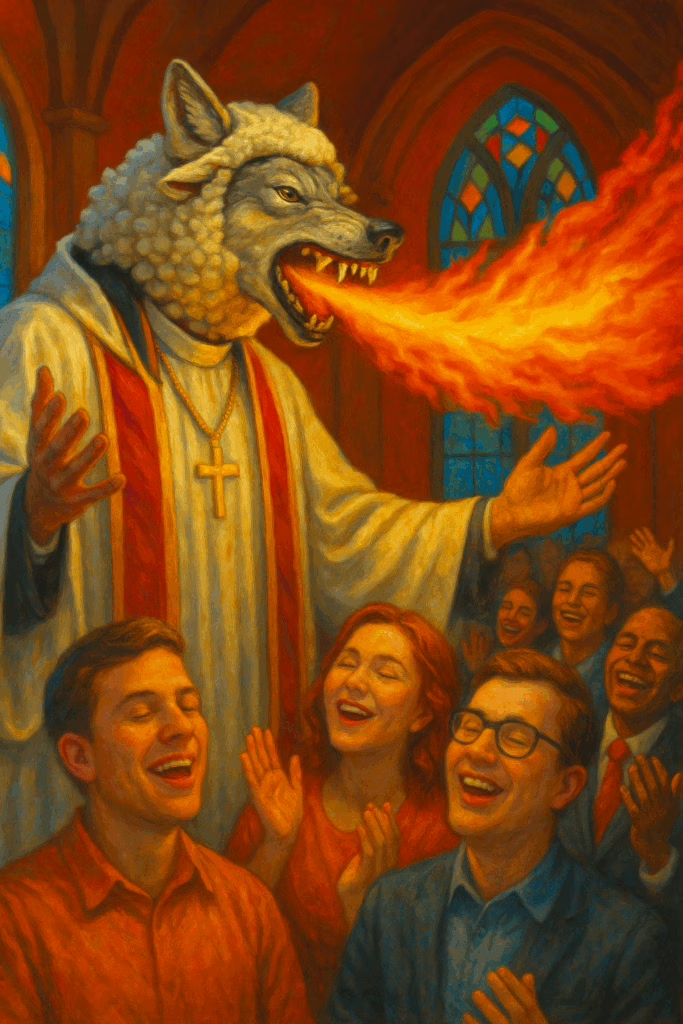
Fire = Passion/Energy (A Modern, Non-Biblical Interpretation)
In many charismatic and Pentecostal circles today, the word “fire” is often used to describe emotional fervor, spiritual excitement, or intense passion for God. Preachers shout phrases like “Feel the fire!” or “Catch the fire!” as if it represents a supernatural charge of energy or motivation.
However, this use of “fire” is not found anywhere in Scripture in connection with the phrase “baptism with fire.” Nowhere does the Bible describe the Holy Spirit’s fire as a burst of emotional energy or a hyped-up spiritual experience.
Instead, throughout the Bible, God’s fire symbolizes judgment, holiness, testing, or purification. Never personal passion or hype. Using “fire” to mean passion or excitement twists the biblical meaning and leads people to seek experiences rather than truth, repentance, and obedience.
“Fire = Passion or Power” — A False Teaching
Many modern preachers, especially in charismatic and Pentecostal circles, have twisted the biblical meaning of “fire” to mean emotional zeal, spiritual passion, or supernatural energy. They shout phrases like:
- “Receive the fire!”
- “I throw the fire of God on you!”
- “Be baptized with fire now!”
- “Holy Ghost fire, burn them!”
These phrases are not biblical and have no foundation in Scripture when used this way. In fact, they completely distort the true meaning of God’s fire.
❗ What These Preachers Actually Do:
- They claim to control God’s power, as if they can summon, send, or throw God’s Spirit or fire at will, like a magician.
- They use “fire” to rebuke or harm others who question or oppose them, treating it as a tool of punishment or status.
- Some even equate fire with deliverance, and claim that demons are burned out with fire. But this looks far more like witchcraft or shamanism than biblical deliverance.
⚠️ Why It is Dangerous and False:
- Nowhere in the Bible do the apostles throw fire at people or command God’s fire on others.
- God’s fire is always under His control, never man’s. God uses it for:
- Judgment (Sodom – Genesis 19:24),
- Testing (1 Corinthians 3:13),
- Or refining (Malachi 3:2–3), but never for show.
- The only ones calling fire down as judgment without God’s command were the disciples, and Jesus rebuked them:
- Luke 9:54–55 – “Lord, do You want us to command fire to come down from heaven and consume them?” But Jesus turned and rebuked them, saying, “You do not know what spirit you are of.”
Why Jesus rebuked them
The disciples asked Jesus if they could call down fire on the Samaritans, but He rebuked them sharply.
Even though they asked, rather than acted, Jesus strongly rebuked them for:
- Assuming God’s wrath was theirs to command,
- Misunderstanding the spirit of His mission, which was mercy, not immediate judgment,
- And for being inspired by the wrong spirit, even while thinking they were being zealous like Elijah.
So, although they did not command the fire, the desire to do so, and the presumption that God would support it, was enough for Jesus to rebuke them firmly.
This shows that the impulse to call down fire on others, even in perceived righteous anger, is not of God. It is of another spirit. And those today who claim to throw or command God’s fire at people are walking in the same misguided spirit.
This rebuke shows that the desire to call fire on people is not from the Holy Spirit, but from another spirit of pride and vengeance.
Jesus is warning them that their thinking, attitude, and desire to call down fire is not born from the Holy Spirit, but from another spirit, and by implication, a demonic one.
It is a strong reminder that zeal without love or truth quickly turns destructive, and that even sincere followers can, at times, speak or act influenced by the wrong spirit if not discerning.
Is this baptism with fire used for purification?
In some other parts of Scripture, fire does symbolize purification (e.g., Zechariah 13:9; Malachi 3:2–3), but in the context of baptism with fire in Matthew 3 and Luke 3, it clearly refers to judgment only, not a cleansing process.
The reference to “baptism with fire” in Matthew 3:11–12 and Luke 3:16–17 does not include purification alongside judgment.
Here’s why:
- The passage speaks of wheat and chaff: It is a metaphor not for refining, but for separating the useful (the righteous) from the worthless (the unrepentant).
- The wheat is gathered: It is a symbol of salvation.
- The chaff is burned with unquenchable fire: It is a symbol of final, eternal judgment.
There is no indication of purification or refinement here. Chaff is not refined, it is eliminated.
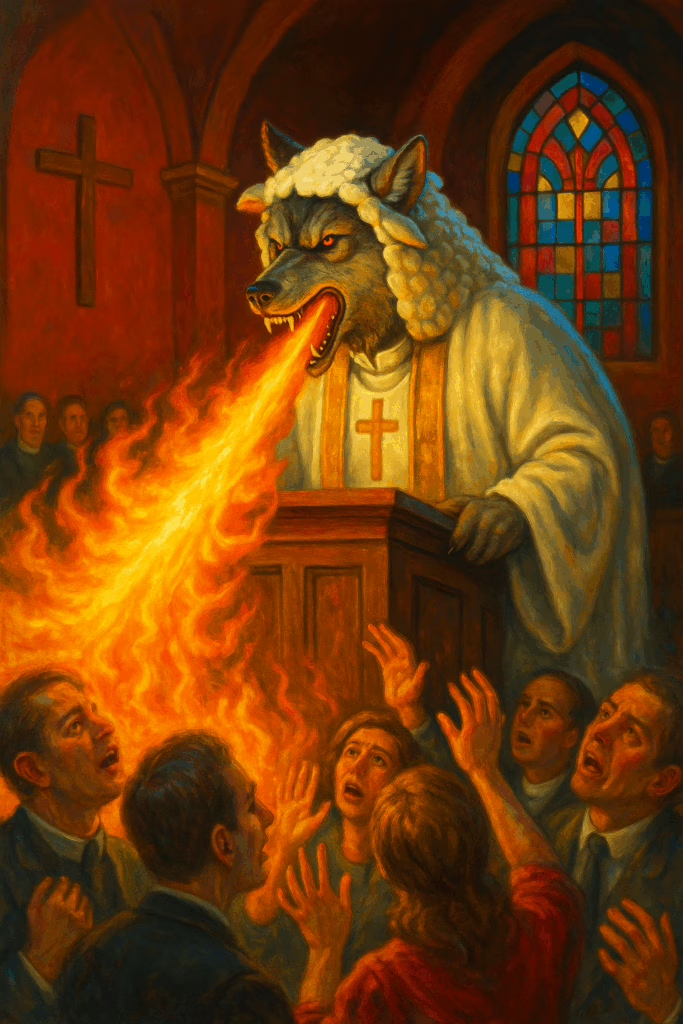
What does Baptism with fire really mean then?
Context clarifies meaning:
The context of the phrase “baptism with the Holy Spirit and fire” is made clear by the very next verse in both Matthew and Luke.
In Matthew 3:12, it says, “His winnowing fork is in His hand, and He will clear His threshing floor and gather His wheat into the barn, but the chaff He will burn with unquenchable fire.”
This confirms a clear separation: the wheat represents the true believers who receive the Holy Spirit. The chaff symbolizes the unrepentant or false believers who are destined for judgment by fire. It is clear then, that the Messiah brings two distinct baptisms. One of life and renewal through the Spirit, and one of wrath and destruction through fire.
Fire meaning Judgment, is most consistent with the immediate context. The “baptism with fire” refers to the unquenchable fire of judgment. This aligns with the Old Testament view of fire as a symbol of God’s wrath (e.g., Malachi 4:1).
In Scripture, the fire of God consistently symbolizes His wrath and judgment, especially in its final and eternal form. This is seen both in temporal judgments (like Sodom and Gomorrah) and in the eternal judgment awaiting the unrepentant, which is described as hellfire, the fire of Gehenna.
Did Jesus ever baptize anyone with fire?
- Not during His earthly life
- Not upon His followers
- Not as a symbolic act
The baptism with fire is future and judgmental.
It is not a spiritual gift.
It is not a cleansing ritual.
And it certainly is not something any preacher today can control or replicate.
The Truth: Baptism of the Holy Spirit and fire
- The phrase “baptism with fire” in Scripture always points to God’s judgment, not emotional hype or dramatic power.
- True spiritual refinement or testing is done by God through trials and His Word. Not through a man throwing imaginary fire on others.
🔥 FIRE = GOD’S WRATH AND ANGER
Here are clear examples:
- Sodom and Gomorrah (Genesis 19:24)
“Then the Lord rained on Sodom and Gomorrah sulfur and fire from the Lord out of heaven.”
This was not natural fire. It was God’s own wrath poured out on sin. - Deuteronomy 4:24
“For the Lord your God is a consuming fire, a jealous God.”
This speaks of God’s holiness and wrath against idolatry and sin. - Isaiah 66:15–16
“For behold, the Lord will come in fire… with His chariots like the whirlwind, to render His anger in fury, and His rebuke with flames of fire.” - Malachi 4:1
“…the day is coming, burning like an oven, when all the arrogant and evildoers will be stubble… it will leave them neither root nor branch.”
🔥 Gehenna is the Final Place of God’s Wrath
Jesus Himself often used Gehenna as the picture of the final judgment:
Mark 9:43
“…to go into hell (Gehenna), into the unquenchable fire.”
Matthew 10:28
“…fear Him who can destroy both soul and body in hell (Gehenna).”
Gehenna refers to:
A real place outside Jerusalem where garbage and corpses were burned, but this symbolically pointing to the final, eternal judgment of the wicked.
This is not just “the absence of God”, it is the active and eternal expression of His anger against unrepented sin.
This means:
The fire of God is not emotional fervor or “passion”> It is consistently a symbol of His:
- Holy judgment against evil,
- Cleansing wrath against impurity,
- And in the case of Gehenna, His eternal punishment.
Hellfire is the full outpouring of God’s eternal anger and judgment.
“Those who claim to baptize with fire are playing with fire. And those who play with fire always get burned.” ~Prof. Francois Meyer~
This is not just a clever phrase.
It is a serious warning.
Those who falsely claim to control God’s fire, invoking it for show, manipulation, or to condemn others, are taking God’s holiness lightly.
Scripture is clear:
“Our God is a consuming fire.” – Hebrews 12:29
You cannot summon, throw, or command what belongs to God alone. The fire of God is not a toy. It is His righteous anger, His holy judgment, His purifying presence.
It is never something for man to use for personal gain or pride.
Just like Nadab and Abihu offered unauthorized fire before the Lord in Leviticus 10:1-2, those who claim to wield “fire” without God’s instruction face the same danger. They will be consumed by the very thing they misuse.
Those who falsely claim to control God’s fire, invoking it for show, manipulation, or to condemn other, are treating God’s holiness with contempt. They reduce His consuming fire to a theatrical display, as if it were theirs to wield.
But the Written Word of God is clear:
“Our God is a consuming fire.” – Hebrews 12:29
Such behavior is not only irreverent.
Such behavior is mocking God.
And mocking God is blasphemy.
Therefore, those who do this, those who claim to baptize with fire:
Repent. Turn from your wicked ways.
For if you do not, you will not escape the fiery judgment of God.
You may throw pretend fire now, but soon God Himself will baptize you in the all-consuming fire of His fury. Not to purify, but to destroy.
Fear God.
Tremble at His Word.
And never claim His power as your own.
To be baptized with fire in the context of Matthew 3:11–12 means to be fully immersed, submerged in the wrath and fury of Almighty God. It is not a temporary trial or refining process. It is eternal judgment.
🔥 Baptism with Fire means Immersion in God’s Final Wrath
Those who reject Christ, live in rebellion, or falsely claim God’s power, while mocking His holiness, will not simply be judged. They will be plunged completely into the all-consuming fire of God’s anger, from which there is no escape.
- “The chaff He will burn with unquenchable fire.” – Matthew 3:12
- “They will suffer the punishment of eternal destruction, away from the presence of the Lord…” – 2 Thessalonians 1:9
- “Depart from Me… into the eternal fire prepared for the devil and his angels.” – Matthew 25:41
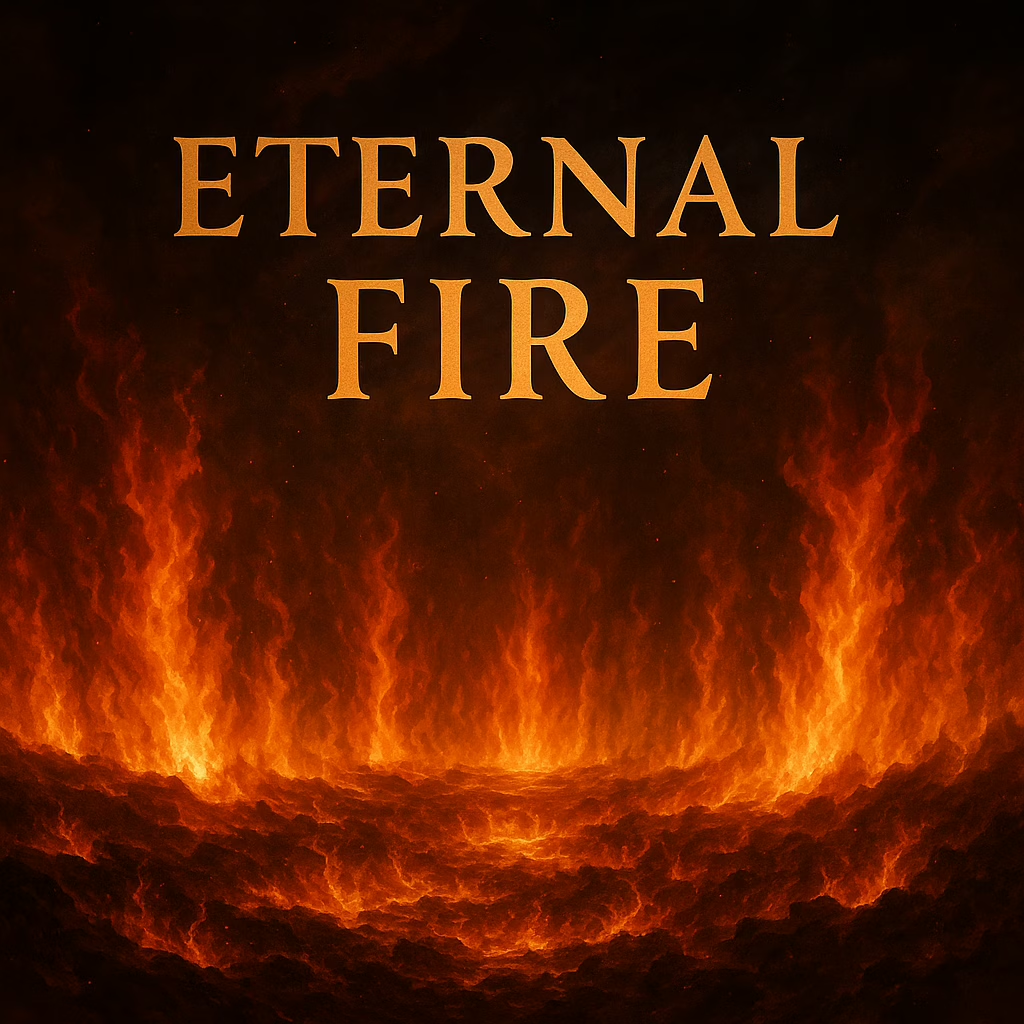
Everlasting Separation
This is not just pain.
This is eternal separation from God’s presence, goodness, and mercy.
They will be completely cut off, abandoned to the torment they chose by refusing to repent.
“The smoke of their torment goes up forever and ever…” – Revelation 14:11
Summary on baptism with fire:
To be baptized with fire, destined for the unrepentant, is to be:
- Fully immersed in God’s wrath.
- Burned as chaff, not refined as gold.
- Separated eternally from God’s presence.
- Left to face the fury of the Righteous Judge without a Savior.
It is the most severe and final fate. And that is why the warning is so urgent:
“Flee from the wrath to come” (Matthew 3:7).
Final Warning:
If you claim to blow, throw, breathe, or baptize with fire — REPENT NOW!
Stop your prideful displays and spiritual vanity. You are not God. You do not control His Spirit or His fire.
Humble yourself before the Lord while there is still time.
Because the day is coming when God Himself will baptize the unrepentant with the fire of His wrath. This fire cannot be quenched. On that day, there will be no theatrics, no shouting, no stage.
Only Judgment.
Turn from your deception. Fear God. Repent.
Before the final baptism comes, and you are fully immersed in the all-consuming fire of His fury.
Here are more Biblical facts you must know…
Is blowing the Holy Spirit in church biblical?
Is being slain in the Spirit biblical?
May God bless you with a teachable spirit and a heart that passionately seeks the truth. – Dr. Francois Meyer –